Cup Clearance: Fitting a Tall Travel Mug Under Your Espresso Machine
A compact espresso machine solves one counter problem and quietly creates another: the gap between the spout and the drip tray is often too short for anything taller than a standard mug. Here is why that happens, the one spec that actually tells you, and how the compact machines in this guide stack up once you go looking for it.
Reader-supported: we may earn a commission if you buy through our links, at no extra cost to you. Prices below are what our database recorded in the week of October 10, 2026, and they move constantly on Amazon — confirm the live price before buying.
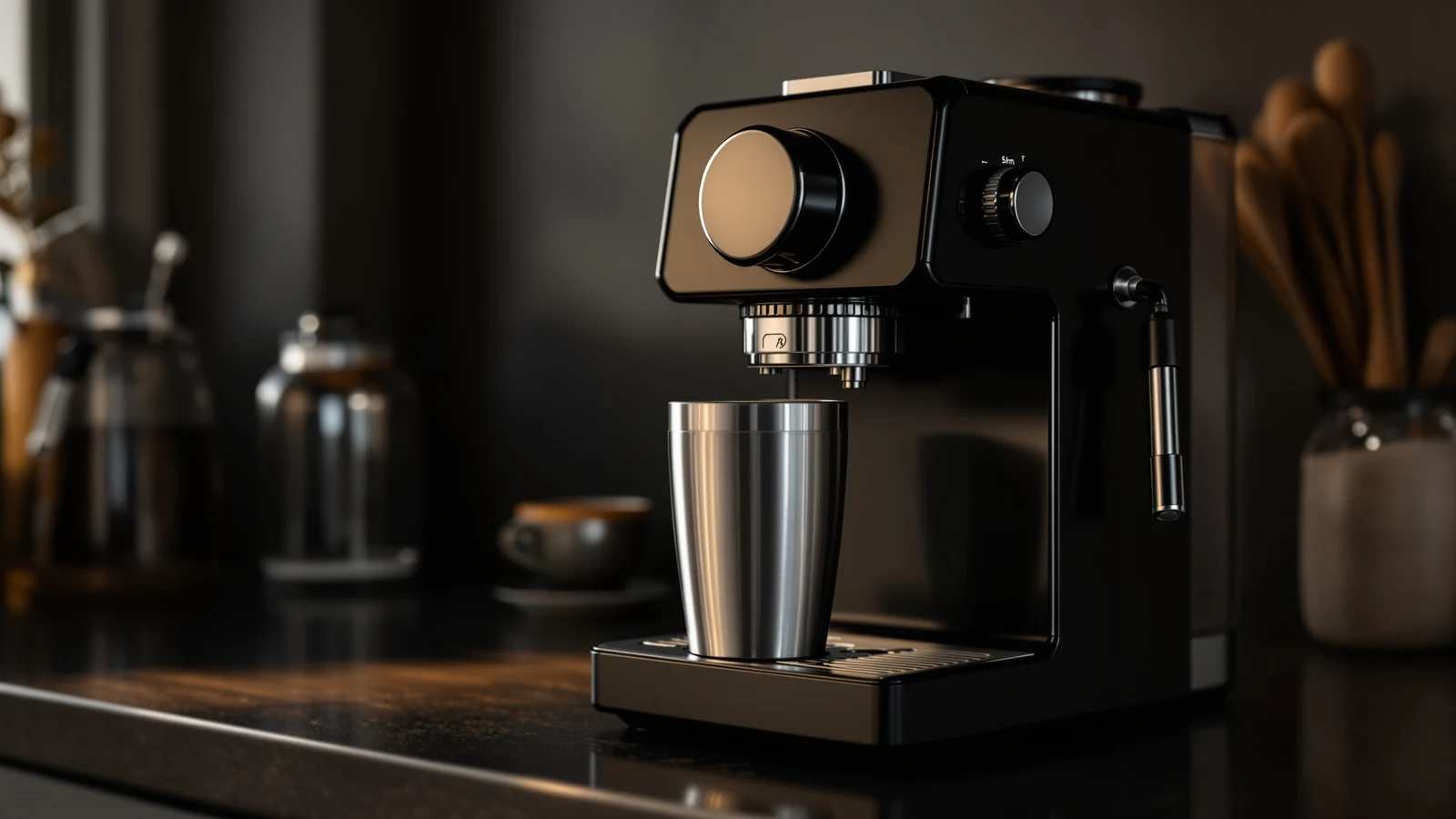
The short answer
Do not trust "compact" as a proxy for "fits my mug." A small footprint tells you about counter width and depth; it says nothing about the vertical gap between the spout and whatever sits under it, and that gap is the only number that decides whether your 20-ounce tumbler goes under the machine or gets filled some other way.
Two things change that gap for the better. One is a removable drip tray, which on some machines lifts clean off its riser and hands back real height. The other is simply measuring before you buy instead of after, because the spec that matters is almost never printed on the listing in plain language — you have to go looking for it, or measure it yourself once the box is open.
Why compact machines are the ones that struggle
The spout on a semi-automatic espresso machine sits at a fixed height, set by where the brew group and portafilter lock in. Below it sits the drip tray: a shallow pan, usually on a small plastic or metal riser, that catches overflow and keeps the counter clean. Your cup sits on top of that riser, so the real clearance is the spout height minus the tray-and-riser height — and neither of those numbers is the one printed on the box as "machine height."
Compact machines are built to minimize overall footprint and height, which is exactly what makes them attractive on a narrow counter or in a shared office pantry. But shrinking the whole machine does not proportionally shrink the spout-to-tray gap. The brew group, the portafilter, and the clearance a 51 mm or similar portafilter needs to swing in and lock under the spout all take up a roughly fixed amount of vertical space regardless of how tightly the rest of the machine is packaged. The result is that the dimension nobody markets — the air between the spout and the tray — gets squeezed hardest on exactly the machines sold as space-savers.
For scale, a standard ceramic mug runs about 3.5 to 4 inches tall. Insulated travel tumblers and reusable mugs commonly run 6.5 to 7.5 inches or more — that is a general fact about drinkware, not a claim about any machine on this page — and that extra 2.5 to 3.5 inches is exactly the margin a compact espresso machine was not designed to give you. The mug that fits your car's cup holder and your gym bag is frequently the mug that will not fit under the spout.
Removable drip trays: the fix most people don't check for
On many semi-automatic machines, the drip tray and its grate are not fixed in place — they lift straight out, and with them goes the riser height they were sitting on. Pull the tray and the cup can sit directly on the machine's base plate or drainage deck instead of on top of a pan, which on some designs reclaims close to an inch of usable height. For a tall tumbler that is often the entire difference between "doesn't fit" and "fits with room to spare."
The catch is that whether a given machine's tray actually comes out, and how much height doing so frees up, is not something Amazon listings reliably state. When we compiled the spec sheet behind this guide, not one of the four compact machines below published a tray-removed clearance figure — manufacturers publish the drip tray as a feature ("removable for easy cleaning") without ever framing it as a clearance fix, so the number you actually want has to be inferred from product photos, the Q&A section on the listing, or the manual itself.
There is also a real trade-off to removing the tray, not just a free inch of height. The tray exists to catch the inevitable drips and the last few drops after a shot finishes. Take it away and you are relying entirely on the mug being positioned correctly and on wiping the counter yourself — fine for an occasional tall-mug pour, less fine as a permanent daily setup if the counter underneath is wood, or if more than one person in the house uses the machine without knowing the tray is out.
Measuring before you buy: the number that actually matters
The spec that decides this is spout clearance with the tray removed if it's removable, or spout clearance with the tray in place if it is not — not the machine's overall height, not its footprint, and not its weight. Almost no listing states this number outright, so you are measuring rather than reading.
- Measure your tallest mug first. Stand it on a flat surface and measure straight up from the base to the rim. This is the number you are shopping against, not the machine's total height.
- Check the listing photos for a cup already in frame. Side-on product shots sometimes show a mug or cup positioned under the spout — if one is visible, you can estimate scale against the machine's stated overall dimensions, though treat this as a rough read, not a guarantee.
- Search the Q&A section and reviews for "tall cup," "tumbler," or "travel mug." On popular listings, someone has usually already asked or complained about this, and sellers occasionally answer with an actual clearance figure that never made it into the spec table.
- If nothing turns up, ask before you buy. Amazon's product Q&A lets you post a question directly on the listing; a seller or a past buyer answering "the tray lifts out and adds about an inch" is more reliable than guessing from a photo.
- Once the machine arrives, measure it in your own kitchen before deciding it doesn't work. Try the tray removed if it comes out, and measure spout-to-counter with a ruler or tape measure before concluding your mug is simply too tall.
None of this is complicated, but it is a step almost everyone skips, because "compact espresso machine" reads as a solved problem until the first morning a 7-inch tumbler won't slide underneath.
The picks, and what we actually know about their clearance
The four machines below are all built to the same brief: a compact, 20-bar semi-automatic footprint with a milk frother, sized for a small kitchen or a desk. We are naming them because they are representative of exactly the category this guide is about, not because any of them publishes the clearance figure we just spent two sections explaining — none do. What we can tell you is what their actual spec sheets say, and where the gap in the data is.
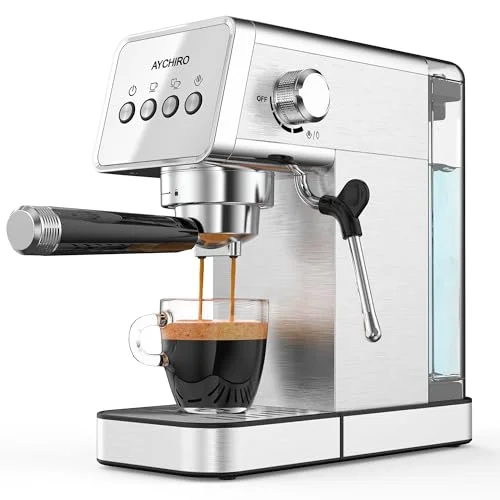
AYCHIRO 20 Bar Espresso Machine
Semi-automatic, 20-bar pump, milk frother wand, 37.2 oz removable water tank, stainless steel compact body. The listing does not state a tray-removed clearance height, so if a travel mug matters to you, check the product photos and Q&A before ordering, or measure once it arrives.
$69.99 Check price →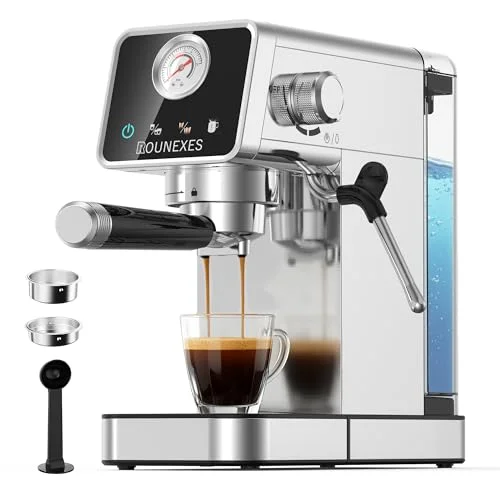
20 Bar Espresso Machine with Pressure Gauge & Touchscreen
Semi-automatic, 20-bar pump, pressure gauge, touchscreen controls, 51 mm portafilter, compact stainless steel body built for home or office. Again, no published tray-removed clearance — the touchscreen and gauge are the headline specs on this listing, and cup height under the spout is not addressed either way.
$99.99 Check price →The BYESHOP 20 Bar Compact Espresso Coffee Machine ($139.99) and the Kismile 20 Bar Espresso Machine ($155.99) follow the same pattern. Both are marketed on compactness, a milk frother, and a 20-bar pump — the Kismile adds a pressure gauge, a 1.4 L water tank, and a hot-water function on top. Neither listing states a spout-to-tray or tray-removed clearance figure, and neither says explicitly whether the drip tray is designed to be removed during normal use or only for cleaning.
| Machine | Price | What's stated | Drip-tray clearance | |
|---|---|---|---|---|
| AYCHIRO 20 Bar | $69.99 | 37.2 oz removable tank, milk frother wand | Not published — check listing / ask | Price |
| 20 Bar w/ Touchscreen | $99.99 | Pressure gauge, touchscreen, 51 mm portafilter | Not published — check listing / ask | Price |
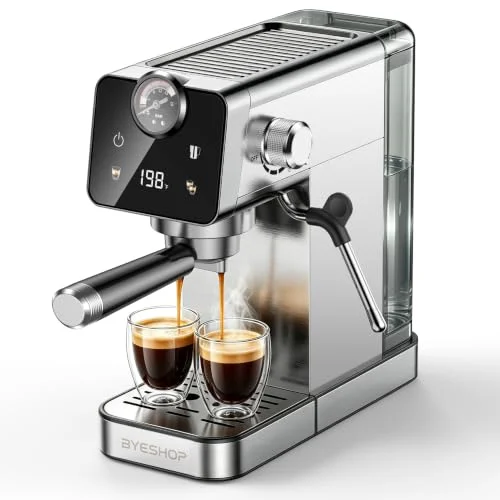 BYESHOP 20 Bar Compact BYESHOP 20 Bar Compact | $139.99 | Milk frother, compact body | Not published — check listing / ask | Price |
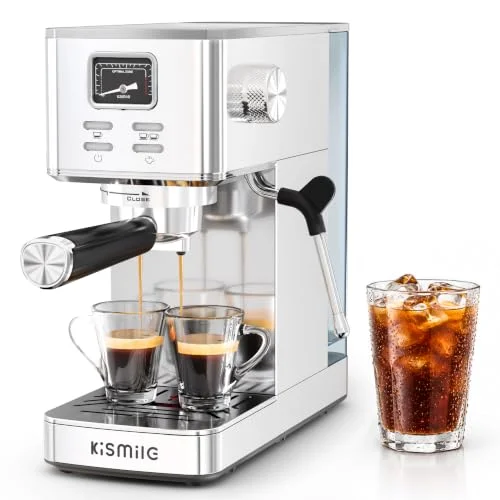 Kismile 20 Bar Kismile 20 Bar | $155.99 | Pressure gauge, 1.4 L tank, hot water function | Not published — check listing / ask | Price |
That empty column is the actual finding of this guide: at this compact, budget-friendly tier of the market, drip-tray clearance simply is not a spec anyone writes down. Price, pump pressure, tank size, and the milk frother get the marketing copy. Whether your mug fits is left for you to discover, which is exactly why the measuring steps above are worth doing before you add any of these — or any similarly compact machine — to your cart.
BYESHOP 20 Bar Compact Espresso Coffee Machine
Semi-automatic, 20-bar pump, milk frother, compact body for small kitchens. No stated tray-removed clearance; the listing's product photos are the best available clue until you have the machine in hand.
$139.99 Check price →Kismile 20 Bar Espresso Machine
Semi-automatic, 20-bar pump, milk frother, pressure gauge, 1.4 L water tank, hot-water function for Americanos or pre-warming a mug. Compact stainless steel body; clearance under the spout with or without the tray is not part of the published spec sheet.
$155.99 Check price →Working around low clearance without buying a new machine
If you already own a compact machine and discovered the hard way that your travel mug doesn't fit, you have options short of replacing it — our guide to common first-time buying mistakes covers clearance as one of a handful of specs people skip before checkout, and this is the practical fallback once you're past that point.
The simplest fix is to decant rather than brew directly: pull the shot into whatever cup does fit — a standard mug, a shot glass, or the small espresso cup that may have shipped in the box, which our guide to what actually comes in the box covers by price tier — then pour it into the travel mug afterward. It adds thirty seconds and one extra dish, but it works with any machine regardless of clearance, and it is the workaround that costs nothing.
If the drip tray on your machine is removable, pulling it out before brewing is worth trying even if the listing never confirmed how much height it buys back — you lose the splash catcher but may gain enough clearance to brew straight into the tumbler. Put a kitchen towel under the spout while you test it, since you are briefly giving up the one part of the machine built to catch mess.
Where you place the machine also matters more than people assume. A compact machine on a counter with an overhead cabinet is a double clearance problem — the cabinet above can force you to pull it forward to use it at all, which our guide to office espresso machines gets into for shared counters specifically. Moving the machine to an open stretch of counter, even temporarily, removes one constraint and makes the mug-height problem the only one left to solve.
When a taller machine is the honest answer
Decanting works, but it is a workaround, not a fix, and workarounds you perform every single morning eventually stop feeling worth it. If your daily habit genuinely is "fill the 24-ounce tumbler and walk out the door," and no amount of measuring or tray-removing gets you there reliably, the honest advice is to stop fighting the compact category and compare machines built with more vertical room between the spout and the base.
That generally means looking outside the budget-compact tier this guide covers, toward semi-automatic or bean-to-cup lines from established brands, where product pages and manuals are more likely to state usable cup height because taller clearance is sometimes sold as a feature rather than left undocumented. Our Breville comparison and De'Longhi comparison are reasonable starting points if that is the direction you are headed — read the individual listings for clearance details rather than assuming size class predicts it, for the same reason this whole guide exists.
There is no shame in the workaround, either. A $70–$160 compact machine with a milk frother is genuinely good value, and most people brewing one or two drinks a day will never mind the extra pour. Replace it with a taller machine only when the daily friction is real, not because a single awkward tumbler made you doubt a machine that otherwise works.
How we compared these
We compared the four machines above on their published specifications — pump pressure, tank size, portafilter size, included accessories, and price — because that is what Amazon's listings actually provide. We do not physically test these machines, we do not run a testing lab, and we do not publish ratings we cannot verify. None of these products currently carry a published rating or review count in our database, so there are no stars anywhere on this page.
The clearance gap documented throughout this guide is a structural observation about how compact semi-automatic machines are designed and marketed, not a measurement we took ourselves — we have no bench to measure it on, and we say so plainly rather than inventing a number to fill the hole in the data. Where we recommend checking a listing's Q&A or photos, that is the actual, verifiable path to the answer; where we could not find one, we have told you that directly instead of guessing.
Frequently asked questions
Will removing the drip tray void my warranty or cause leaks?
Removing a tray designed to lift out for cleaning is normal use, not damage, and should not affect a warranty on its own — but check your specific machine's manual, since designs vary. The real risk isn't warranty, it's mess: without the tray, drips and the last few drops after a shot land on whatever is underneath, so protect the counter and reposition the mug carefully.
How tall is too tall for a compact espresso machine?
There is no single number across machines, because spout clearance depends on each model's brew group height and tray design, and that figure is rarely published. As a general guide, a standard mug (about 3.5–4 inches) usually clears compact machines without issue; insulated tumblers and travel mugs at 6.5 inches or taller are the ones most likely to need the tray removed, a different mug, or a decant-and-pour routine.
Can I fit a large insulated tumbler under a compact espresso machine?
Sometimes, and it depends on the specific machine rather than on "compact" as a category — which is the core point of this guide. None of the four machines covered here publish a tray-removed clearance figure, so the reliable path is checking listing photos and the Q&A section, asking the seller directly, or measuring once the machine is in your kitchen.
What's the easiest workaround if my mug doesn't fit?
Pull the shot into a smaller cup — a standard mug or the small cup that may have shipped in the box — and pour it into your travel mug afterward. It costs thirty seconds and an extra dish, but it works regardless of your machine's clearance. If the drip tray is removable, trying the brew with it out, over a towel, is the next thing worth testing before deciding you need a different machine.