Best Espresso Machines
Budget picks · Under $200

The best espresso machines under $200 — and what you give up.

Exactly one machine under $200 comes with a burr grinder inside it. That single fact decides how a $200 budget should be spent, and most buying guides in this bracket never mention it.

By Ilane Tall · Updated August 12, 2026 · Research-based.5 machines under $200 compared

Compact stainless steel budget espresso machine on a small kitchen counter with a portafilter and cup

Reader-supported: if you buy through the Amazon links here we may earn a commission at no extra cost to you. It never changes which machine we recommend.

Under $200 is where most people start with espresso, and where the category does its worst marketing. Listings here lean on one number — 20 bar — and on stainless-look plastic shot in flattering light. What separates a machine you'll still use in two years from one that ends up in a cupboard is less glamorous: the grinder, the boiler, and whether the basket is single-wall or a pressurised imitation.

We took the machines in our database priced at or below $200, plus the two nearest step-ups, and sorted them by what they physically are rather than by what the box claims. The field is small once you drop near-identical rebadged listings: AMZCHEF with a grinder at $199.99, CASABREWS CM5418 at $139.99, CASABREWS 3700 at $99.99, Chefman CraftBrew at $79.99, and a $54.99 Mr. Coffee from a different appliance class entirely.

The short answer

If you only read one paragraph

Buy the AMZCHEF at $199.99 if you have the full $200

It's the only machine at or under $200 in our data with a built-in grinder — 44 settings — plus brew-temperature control from 190 to 201 °F, a 60 oz tank, a cold-brew mode and a descaling function. A grinder inside the price is what makes it the value pick, not the cheap pick.

If $200 is too much, the CASABREWS 3700 Essential at $99.99 is the sensible half-price option and the Chefman CraftBrew at $79.99 is the floor we'd still buy. Below that sits the Mr. Coffee 4-Shot Steam at $54.99, which is steam-driven and doesn't brew at espresso pressure at all. Step-ups, honestly labelled: CM5418 at $139.99, Gevi with grinder at $287.97, Breville Bambino at $299.95.

At a glance

The sub-$200 field, side by side

Ordered by price. Dimensions are listed only where the manufacturer data states them. Prices move constantly; confirm before you buy.

MachinePricePump or steamGrinderMilkFootprint (W × D × H)
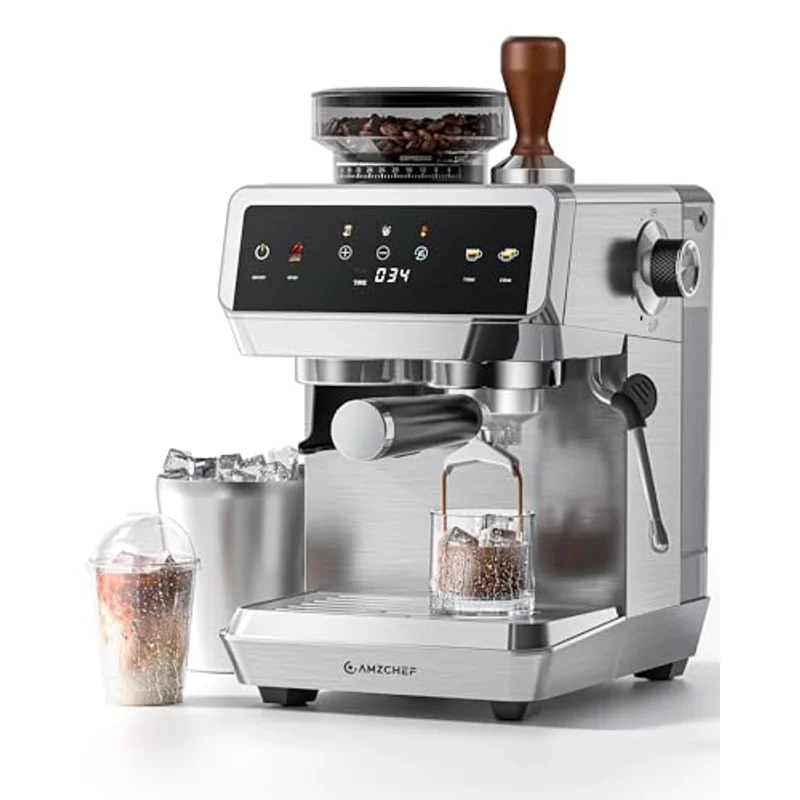
AMZCHEF with Grinder$199.99Pump semi-autoBuilt-in, 44 settingsManual steam wandNot listed · 60 oz tankPrice
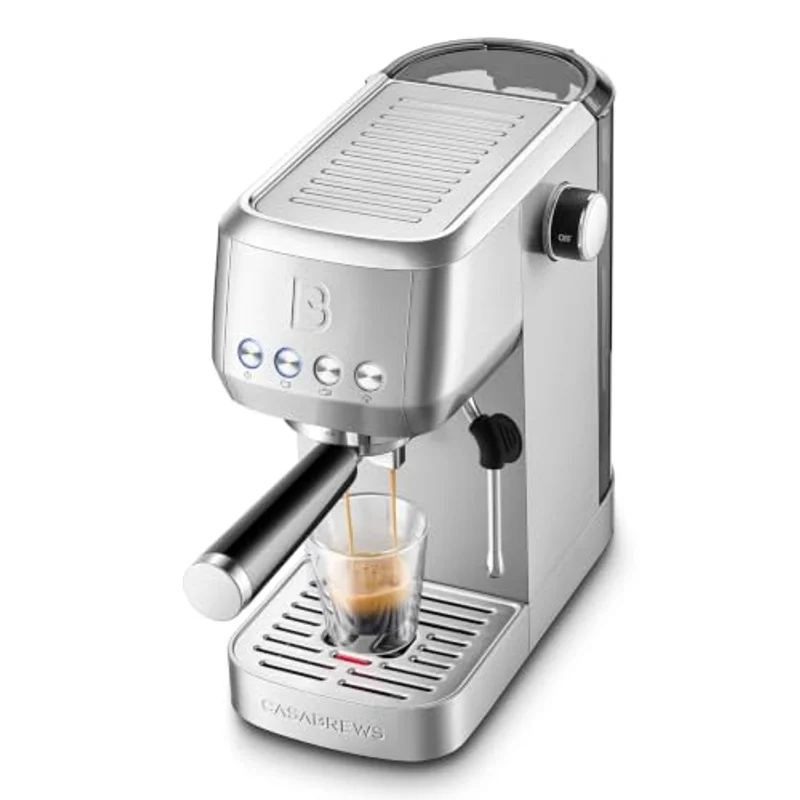
CASABREWS CM5418 Compact$139.99Pump semi-autoNoneManual steam wandNot listed · pressure gaugePrice
CASABREWS 3700 Essential$99.99Pump semi-autoNoneManual steam wand12.6 × 5.7 × 12.2 inPrice
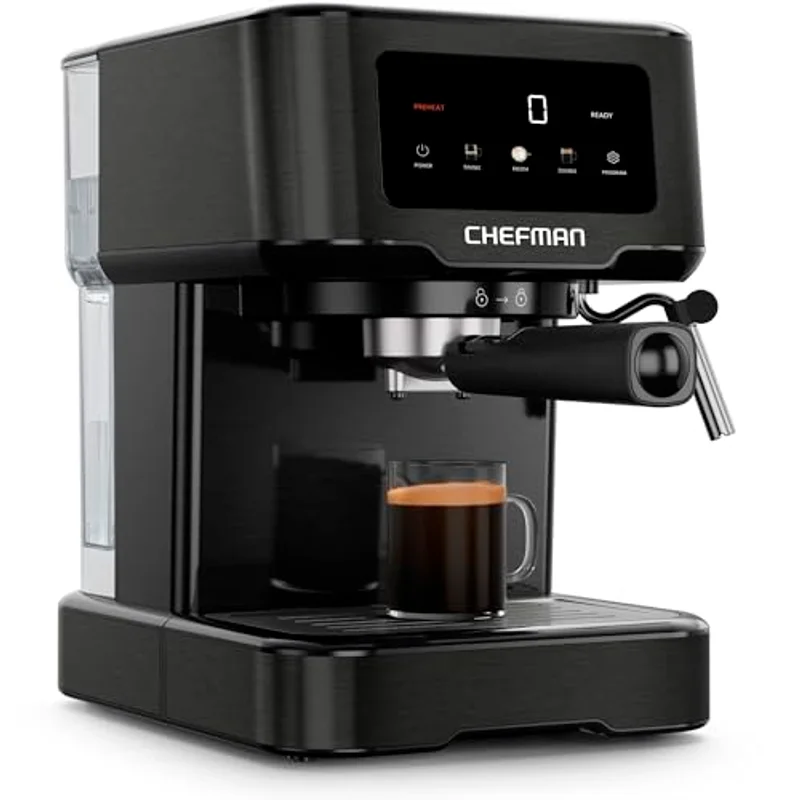
Chefman CraftBrew$79.99Pump semi-auto, 15 barNoneManual steam wandNot listed · 1.5 L tankPrice
Mr. Coffee 4-Shot Steam$54.99Steam-drivenNoneFrothing wandNot listedPrice

Just over the line: the Gevi 20 Bar with grinder at $287.97, and the Breville Bambino at $299.95.

The picks

Five machines, five different buyers

01Best under $200

AMZCHEF Espresso Machine with Grinder

The only sub-$200 machine that doesn't need a second purchase
Pump semi-automatic · built-in grinder, 44 settings · brew temp 190–201 °F · 60 oz tank · cold-brew mode · descaling function

Everything else in this bracket assumes you already own a grinder. This one doesn't, which changes the arithmetic completely: a burr grinder is the component that most determines whether espresso tastes like espresso, because extraction depends on even particle size and on grinding shortly before you brew. Buy a $100 machine here and you still owe $80 to $200 for one; buy this and it's inside the $199.99. Two other specs are rare here: brew-temperature control from 190 to 201 °F, useful because lighter roasts extract better at the hotter end of espresso's 195 to 205 °F range, and a documented descaling function, which matters because limescale is what kills home machines.

The trade-offForty-four grind settings on an entry-level grinder is a range, not a promise of precision: expect a narrow useful window and a week of finding yours. AMZCHEF is also a smaller brand than Breville or De'Longhi, so parts and support are less established.

AMZCHEF espresso machine with built-in grinder
$199.99
Grinder includedCheck price →
02Best under $100

CASABREWS 3700 Essential

Half the budget, and only 5.7 inches of counter
Pump semi-automatic · 1,350 W boiler · manual steam wand · stainless · 12.6 × 5.7 × 12.2 in

Buy this if you want to find out whether you actually enjoy making espresso before committing real money. It has the two things that make a machine teachable — a portafilter you load yourself and a manual steam wand you have to learn to use — and the 1,350 W element heats fast for its size. The spec worth staring at is 5.7 inches wide, narrower than most dish racks, which is why it turns up in apartments, offices and dorms where a bean-to-cup machine can't go; at 12.2 inches tall it clears most wall cabinets too.

The trade-offNo grinder, so budget one separately. And a small boiler makes milk work sequential — shot, wait, froth. Fine for one or two drinks, tiresome at four.

CASABREWS 3700 Essential compact stainless espresso machine
$99.99
5.7 in wideCheck price →
03Cheapest worth buying

Chefman CraftBrew

The floor price for a real pump machine
Pump semi-automatic · 15-bar pump · 1.5 L removable reservoir · digital programmable shot volume · two shot baskets

At $79.99 this is where we'd refuse to go lower. The 15-bar pump comfortably clears the roughly 9 bar espresso needs at the puck, the 1.5 litre reservoir lifts out so you fill it at the tap, and two baskets let you brew a single or a double properly. The digital panel with programmable shot volume sounds like a gimmick and isn't: espresso is a ratio — commonly 18 grams in, 36 out, in 25 to 30 seconds — so repeating a set volume lets you change one variable at a time, usually the grind. The full routine is in how to pull a good espresso shot.

The trade-offNo grinder, a small boiler, and plastic where pricier machines use steel. A starting point, not a machine you keep for a decade — buy it knowing that.

Chefman CraftBrew espresso machine with digital control panel
$79.99
15-bar pumpCheck price →
04The step-up

CASABREWS CM5418 Compact — and the two machines just over the line

If your budget is elastic by $40, or by $100
Pump semi-automatic · 1,350 W · built-in pressure gauge · stainless · $139.99

The CM5418 is the 3700's idea plus one thing that earns its $40: a pressure gauge, which makes an invisible process visible. Needle pins immediately, the grind is too fine or the dose too large; barely moves, too coarse. Nothing else in this bracket gives you feedback while the shot runs, and feedback is how you improve in days rather than months. Still no grinder.

Above budget, two machines deserve naming honestly rather than pretending they're under $200: the Gevi 20 Bar with Grinder at $287.97, with a 30-setting conical burr and adjustable grind, strength and temperature at 11.5 × 12.01 × 16.53 in, and the Breville Bambino at $299.95, which has no grinder but an automatic microfoam wand with adjustable milk temperature and texture. If milk drinks are most of what you make, Bambino plus a separate grinder is a better long-term spend than anything on this page.

The trade-offBoth step-ups break the $200 rule this page is built on. We name them because a budget that flexes by $100 changes the right answer.

$139.99
Pressure gaugeCheck price →
05Skip at this price

Mr. Coffee 4-Shot Steam

A perfectly decent appliance that is not an espresso machine
Steam-driven, not a pump machine · brews up to 4 shots · extra-large portafilter · stainless frothing pitcher · $54.99

The $25 saving looks obvious until you know how the machine works. A pump machine forces water through the coffee with an electric pump. A steam machine has none: it seals a boiler and heats water until steam pressure pushes it through the grounds, which generates a fraction of what a pump produces — espresso brews at roughly 9 bar at the puck, and steam machines operate well below it.

Two things follow. There's no real crema, because crema is oils and dissolved gas emulsified under pressure. And steam-driven water arrives hotter and less controlled than the 195 to 205 °F espresso wants, pushing the cup bitter. What you get is strong stovetop-style coffee, closer to a moka pot than a café shot — a drink plenty of people like, and a cheap way to get it.

The trade-offIf you want espresso — crema, a 25-second extraction, a shot you can dial in — the $25 saved here is a false economy, because no technique gets a steam machine to pump pressure. Spend the extra and start with the Chefman.

$54.99
Steam-drivenCheck price →
The honest part

What you actually give up under $200

None of this makes a budget machine a bad buy. It makes it a machine with known limits, which is easier to live with than a surprise.

Temperature stability

Expensive machines hold brew temperature within a degree or two with a PID controller, a feedback loop that modulates the element continuously. Nothing in this bracket lists PID control or claims stability as a spec; these use simple thermostats that overshoot and undershoot a set point. That means variation you can taste: same coffee, same grind, same dose, slightly different cup. The AMZCHEF's 190–201 °F control is the closest thing here, but setting a target isn't holding it.

Boiler capacity, which really means waiting

A 1,350 W element in a small single boiler heats a little water quickly, which is why these machines are ready in under a minute and why they can't brew and steam at once. Every milk drink is a three-step wait: pull the shot, wait for steam temperature, froth, then wait for the boiler to drop or you'll scorch the next shot. Fine for one flat white; for four drinks before school, the waiting is what kills the habit.

Pressurised baskets that fake crema

Budget machines very often ship pressurised, or dual-wall, baskets: a second wall with a tiny hole that creates artificial back-pressure, so almost any grind produces foam on top of the coffee. It looks like crema, it's mostly aerated bubbles, and it collapses in seconds. A forgiving basket makes supermarket pre-ground drinkable, but it hides your mistakes, so grinding better changes nothing you can see. Our data lists two baskets for the Chefman without specifying type, so check the photos — single-wall has dozens of fine holes, dual-wall a smooth base with one pinhole.

Plastic, and thinner hardware

Stainless at this price is often a steel skin over a plastic chassis, and the parts that wear are usually plastic. Portafilters are thinner than the heavy brass ones on expensive machines, which store heat and stabilise the shot, so a cheap one pulls heat out of the water at the worst moment. Preheating fixes much of that: run a blank shot through the empty portafilter first, and warm the cup.

No grinder, with one exception

Only the AMZCHEF includes one. Every other machine here needs $80 to $200 of grinder standing beside it, or a hand grinder for less — the subject of the next section.

Warranty and support

Coverage here is thin. Our data records a one-year limited warranty for the $685 Breville Barista Express and no warranty terms at all for the budget machines on this page. Assume a year, assume parts availability isn't guaranteed, and accept that a $90 machine failing in year three is a replacement, not a repair. What you do control is scale: limescale is the main killer of home machines, frequency depends on water hardness, and the manufacturer's descaling routine is the cheapest life extension there is — see how to clean and descale an espresso machine.
The decision that matters

A $100 machine plus a real grinder beats a $200 machine with pre-ground coffee

Espresso is the most grind-sensitive brewing method there is. You're pushing water through a compressed bed of coffee in about 25 to 30 seconds, and the only lever controlling how fast it gets through is particle size — change the grind by a hair and a sour, fast shot becomes balanced. Blade grinders can't do this: they chop coffee into boulders and dust, the dust chokes the basket, the boulders barely extract. Burr grinders crush beans between two surfaces at a set distance, producing the even particle size espresso requires.

An electric burr grinder good enough for espresso generally runs $80 to $200; a hand grinder costs considerably less and often grinds better than a cheap electric at the same price, the compromise being a minute of cranking per double. Add that to the machine price:

  • AMZCHEF at $199.99 — grinder included, 44 settings. Total to start: $199.99.
  • CASABREWS 3700 at $99.99 plus a hand grinder — a capable setup, well under $200 total.
  • Chefman CraftBrew at $79.99 plus a hand grinder — the cheapest legitimate espresso setup on this page.
  • CASABREWS CM5418 at $139.99 plus an $80–200 electric burr — $220 to $340, above the ceiling.

Those totals assume you buy a grinder at all, which is what most budget guides quietly skip. Feed a $200 machine supermarket pre-ground and you've spent the money on the wrong half of the setup: it's milled for drip, far too coarse for espresso, and stales fast once opened. Both routes are compared in espresso machine with a grinder vs. a separate grinder, including why the grinder is the part you keep when you upgrade.

Marketing decoded

"20 bar" is not brew pressure, and it's on almost every box here

Walk the sub-$200 aisle and 15 bar, 19 bar and 20 bar are splashed across listings as though they were a performance ranking. They aren't. Espresso is brewed at roughly 9 bar at the coffee puck, and that's the figure the method is built around. The number on the box is the vibratory pump's maximum rating with nothing in the way — an unloaded spec, not what reaches your coffee. Machines regulate down with an over-pressure valve or lose the surplus to the resistance of the coffee bed.

Two of our specs make the point. The CASABREWS 3700's advertised 20 bar is a pump maximum, not brew pressure, and our data flags it that way. The Chefman advertises 15 bar and is no weaker for it, because 15 bar of pump maximum already sits above what the puck needs. Once a machine reaches about 9 bar at the coffee, extra headroom changes nothing you can taste.

Why it matters at $200: bar is the only number many of these listings compete on, and it tells you least. Judge them on what changes the cup — grinder, boiler size, basket type, brew-temperature control, width. Two listings differing only in the bar figure are the same machine as far as your coffee is concerned.

Spend in this order

What to buy first, second and third

If you're assembling a setup from nothing, the sequence matters more than the total.

01

A burr grinder

Inside the machine (AMZCHEF, $199.99) or beside it. A hand grinder is the cheap route and grinds better than a cheap electric.

02

A pump machine

$79.99 to $199.99 buys a real pump, a portafilter and a steam wand. Skip steam-driven machines. Measure your counter first.

03

A scale and fresh beans

A cheap gram scale and roast-dated beans beat any spec upgrade at this price. Weigh in, weigh out: about 18 g in, 36 g out, 25–30 seconds.

04

Then a better machine

Six months in, you'll know which limitation to spend on — stability, boiler size or milk — instead of guessing now.

Run the payback math with your own numbers. Assuming a $6 daily café latte (about $180 a month) against a home latte from good beans and fresh milk at under a dollar, a $100 machine plus a $60 hand grinder is repaid inside a month. What that can't tell you is whether you'll still be using it in March — which is why we'd rather see someone start at $80 and upgrade deliberately. Still weighing it? Are home espresso machines worth it makes the case both ways, and semi-automatic vs. super-automatic explains what one-button coffee costs.

How we picked

Every machine at or under $200, sorted by class

We filtered our database to machines at or below $200 and separated them by what they physically are: pump semi-automatic versus steam-driven, grinder or no grinder. Near-identical rebadged listings from unknown sellers were dropped, of which this bracket has dozens. Then we named one machine per buying situation, plus the one we'd steer you away from and the mechanical reason why. Our picks at every price are on the main espresso machine guide.

How we compared

Research, not a lab

Plainly: we compare published specifications and prices, we don't run a testing lab, and we don't publish ratings we can't verify. Amazon's product data returns no rating or review-count figures for these machines, so you'll find no stars and no review totals anywhere on this site — inventing them, or repeating sentiment we can't source, would make this page look more authoritative than it has earned. Everything above comes from spec sheets, machine class, footprint, wattage, tank size and price, plus general coffee facts. Where a call is a judgement, we label it a trade-off.

FAQ

Questions people actually ask

Can you get real espresso for under $200?

Yes, on one condition: it has to be a pump machine and you have to grind fresh. Every pump machine here reaches the roughly 9 bar espresso needs at the puck, so the limit is the coffee, not the machine. The AMZCHEF at $199.99 gets you there in one purchase because the grinder is built in; the CASABREWS 3700 at $99.99 or the Chefman at $79.99 once you add a grinder. What you won't get under $200 is consistency — no machine here lists PID control.

Is a 20-bar espresso machine better than a 15-bar one?

No. Espresso brews at about 9 bar at the coffee puck, and the 15, 19 or 20 bar figure on the box is the pump's maximum with no coffee in the way. Both exceed what the puck needs, so the number says nothing about the cup. Judge the grinder, the boiler, the basket type and the footprint instead.

Should I buy a $200 machine or a $100 machine plus a grinder?

A $100 machine plus a real burr grinder beats a $200 machine fed with pre-ground coffee. Espresso is the most grind-sensitive brewing method there is, and pre-ground is milled too coarse and stales quickly once opened. The exception is the AMZCHEF at $199.99, which includes a 44-setting burr grinder — which is why it's our pick when the full budget is available.

Why avoid the cheapest machines, like the $54.99 Mr. Coffee?

Because it's a different machine class. The Mr. Coffee 4-Shot is steam-driven, not pump-driven: it heats a sealed boiler until steam pressure pushes water through the grounds, producing far less than the roughly 9 bar espresso requires. You get strong stovetop-style coffee rather than espresso with real crema, and no technique closes that gap. A fine appliance if that's the drink you want; a false economy as a cheap espresso machine.

Keep reading

Next steps, in order of usefulness

Ilane Tall

Ilane writes the espresso comparisons on this site, built from published specifications, machine class and live pricing — never from testing we haven't done, and never from ratings we can't verify. Get in touch, or read about this site and our privacy policy.