Semi-Automatic vs Super-Automatic: Which Espresso Machine Suits You?
Amazon sells four fundamentally different machines under the same word. What separates them is not price or looks — it is how much of the work the machine takes off your hands, and how high the cup can go once it does.
Reader-supported: if you buy through a link on this page we may earn a commission, at no extra cost to you. It never changes which machine we recommend.
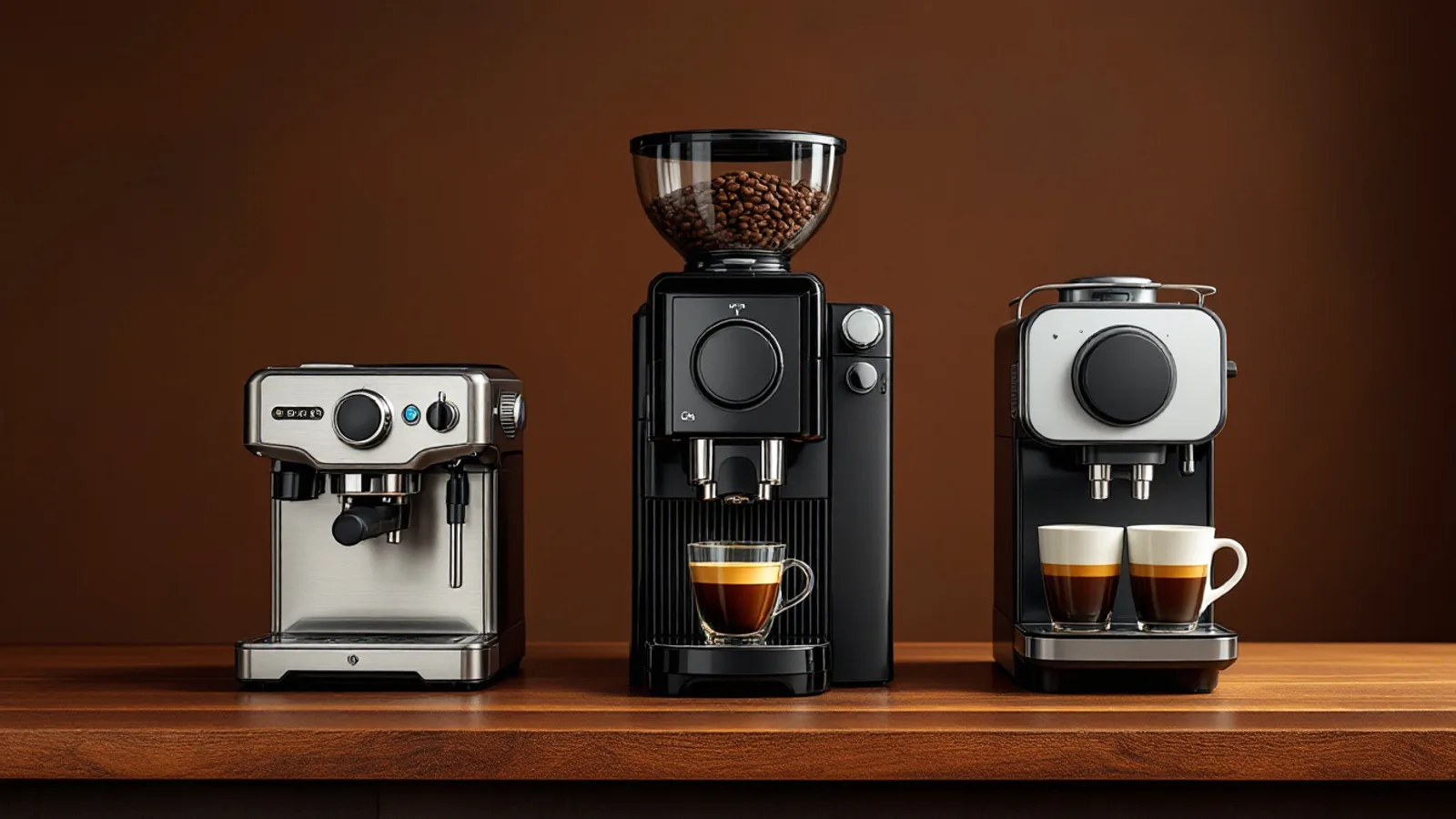
What you're choosing between
- Steam-driven — the sub-$60 machines
- Pump semi-automatic — you grind, dose, tamp, pull
- Super-automatic — one button does everything
- Capsule — no technique, permanent per-cup cost
- Hybrid multi-drink — espresso, drip and cold brew
- The bar myth, the milk decision, which one is you
The espresso section on Amazon is one of the worst-labelled categories in home appliances. A $55 box and a $685 machine both say "espresso maker," both show a crema-topped cup, and both quote a number of bars that sounds impressive. Mechanically they have almost nothing in common — one of them cannot reach espresso pressure at all.
So this guide sorts the category the only way that predicts your mornings: by who does the work. Four real classes, plus one hybrid. For each, here is what it is mechanically, what the routine feels like at 7am, how good the coffee can get, what it costs, what wears out, and who should buy it.
1. Steam-driven: cheap, and not really espresso
A steam-driven machine has no pump. It seals a small boiler, heats the water until steam pressure builds inside, and that pressure pushes water through the coffee — a stovetop moka pot with a wall plug attached. The physics cap it: steam pressure in a small consumer boiler lands in the low single digits of bar, well under the roughly 9 bar that defines espresso extraction at the puck.
What comes out is not bad coffee. It is strong, hot and concentrated, with a thin layer of bubbles that looks a little like crema and disperses much faster. What it will not produce is the syrupy body and dense sweetness you pay $6 for at a café, because that texture comes from pressure.
The routine is simple: fill, wait for the boiler to come up to pressure, turn a dial, and the shot arrives on its own schedule rather than yours. There is no timing to learn because there is nothing to control — nothing to change except grind size. Price is the whole argument: the Mr. Coffee 4-Shot Steam lists at $54.99, wand and pitcher included.
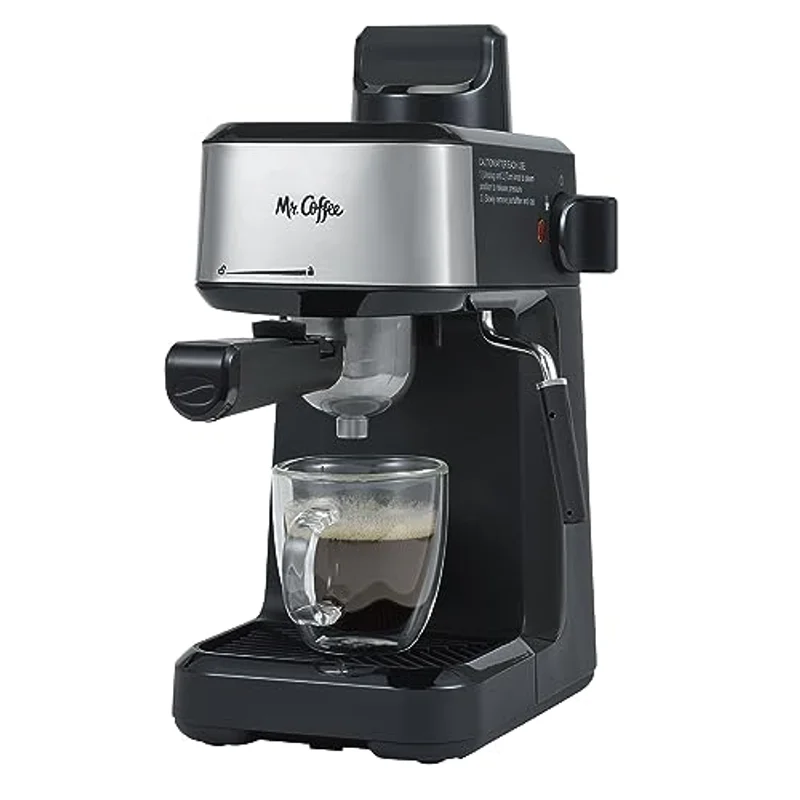
Mr. Coffee 4-Shot Steam
$54.99 · steam-driven (no pump) · no grinder · integrated frothing wand · brews up to 4 shots · extra-large portafilter · stainless pitcher
The honest use case: a cheap way to make strong, milk-friendly coffee. If real espresso is the goal, the extra $25 for a pump machine changes the physics — this one can't get there.
Check price →Wear is concentrated in one place: scale. Limescale is the main killer of home espresso machines, and a machine whose whole principle is boiling water in a sealed vessel is the least forgiving version of that problem. Nothing here is worth repairing either — a failed boiler ends the machine — so descale on the schedule in the manual and treat it as a short-life appliance.
Who should buy it: almost nobody who came here searching for an espresso machine. This is the one class we would steer you away from if the word "espresso" is what you want in the cup. Spend $80 instead and you cross into pump machines — the single biggest step in this guide.
2. Pump semi-automatic: you drive, and the ceiling is high
A semi-automatic uses an electric pump to force water through the coffee at brewing pressure, and hands you the three variables that decide how a shot tastes: grind size, dose, and how long the shot runs. You grind, fill the basket, tamp it level, lock the portafilter in, press start, and stop when there is enough in the cup. The pump is automatic; the judgement is yours.
Mornings here have a rhythm rather than a button. Reasonable target: about 18 g of coffee in, about 36 g of espresso out, in 25 to 30 seconds, then grind finer if it ran fast and coarser if it choked — the whole craft in one sentence, and we walk through it in how to pull a good espresso shot. Expect a couple of weeks of mediocre coffee while you find your setting, plus half a minute a day knocking out the puck and wiping the wand.
In return you get the highest ceiling here. The other classes are as good on day one as they will ever be; this one gets better as you do.
What separates good from mediocre is not the machine, though — it is the grinder. Pre-ground coffee is too coarse and too stale to extract well, and a blade grinder cannot produce an even particle size. So every semi-automatic decision is really two: machine, and burr grinder. We compare the routes in espresso machine with grinder vs separate grinder.
The pump ladder, from $80 to $685
Prices here span nearly a factor of nine, and the money buys three things in this order: a grinder, thermal stability, build quality.
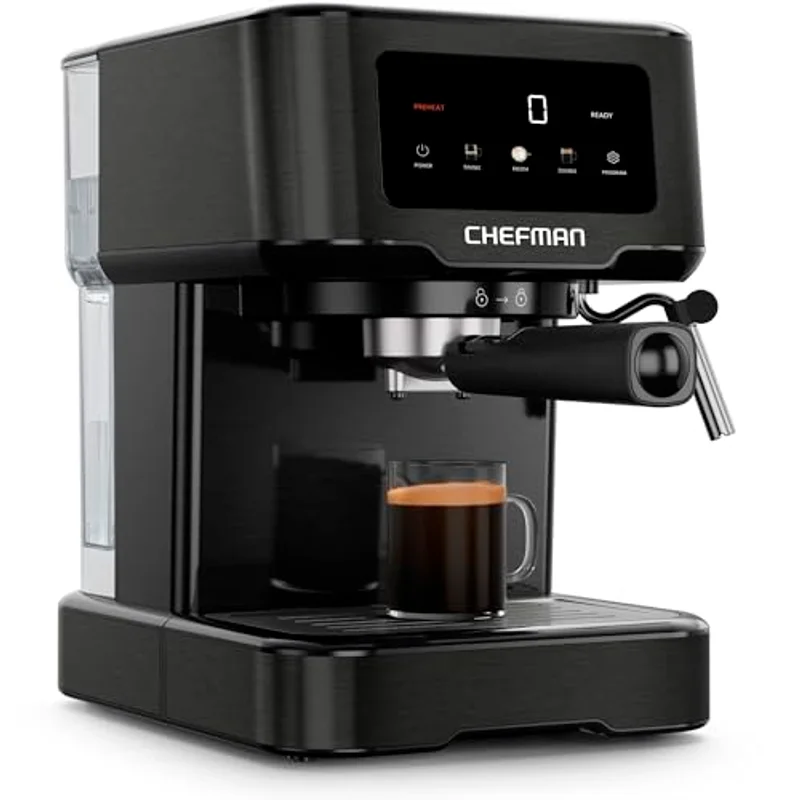
Chefman CraftBrew — $99.99
15-bar pump · no grinder · 1.5 L removable reservoir · digital touch panel with programmable shot volume · two shot baskets · manual steam wand
The floor price for a machine worth owning. Programmable shot volume is the unusual feature: set a ristretto or a longer shot and repeat it, instead of guessing every morning. No grinder, so budget for one.
Check price →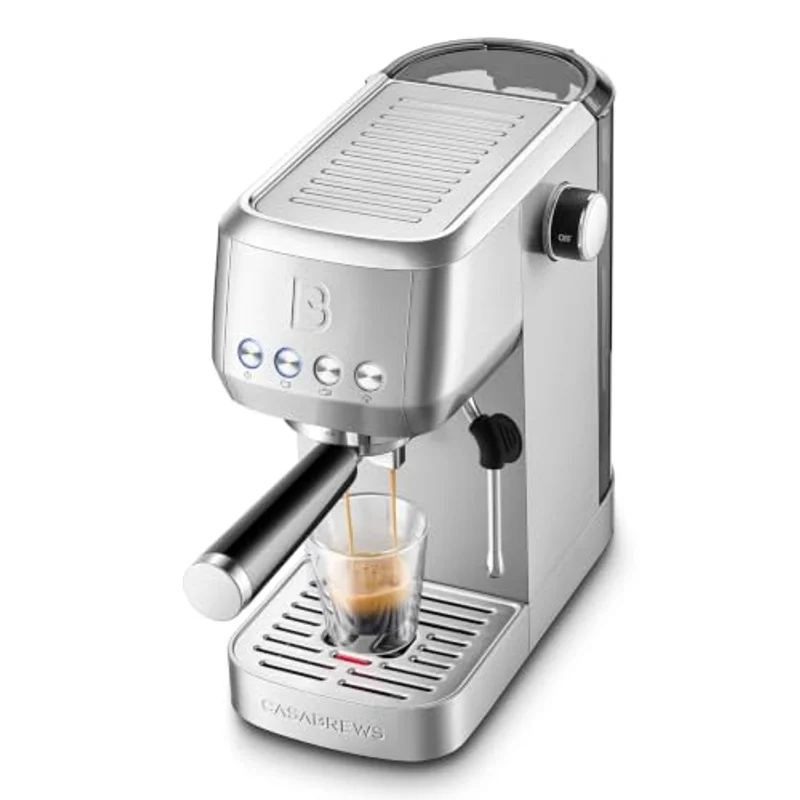
CASABREWS 3700 Essential — $99.99
1,350 W boiler · no grinder · manual steam wand · 12.6 × 5.7 × 12.2 in · stainless · advertised 20-bar pump (pump maximum, not brew pressure)
Only 5.7 inches wide, which is why it lands in small kitchens and offices. A real portafilter and a real wand in stainless under $100; the small boiler means waiting between shot and milk.
Check price →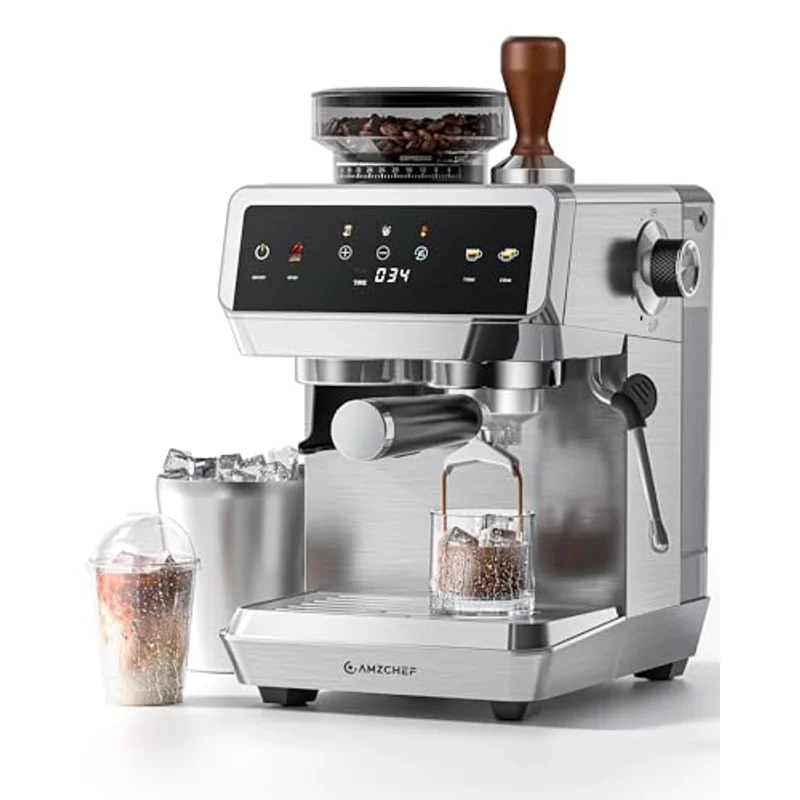
AMZCHEF Espresso Machine with Grinder — $199.99
Built-in grinder, 44 settings · brew-temperature control 190–201 °F · 60 oz tank · cold-brew mode · descaling function · manual steam wand
The cheapest genuinely bean-to-cup semi-automatic we track. Adjustable brew temperature across an 11-degree window is the standout spec — it normally appears several hundred dollars higher — and 44 grind steps leave room to dial in. Newer listing from a smaller brand, so parts and long-term support are the unknown.
Check price →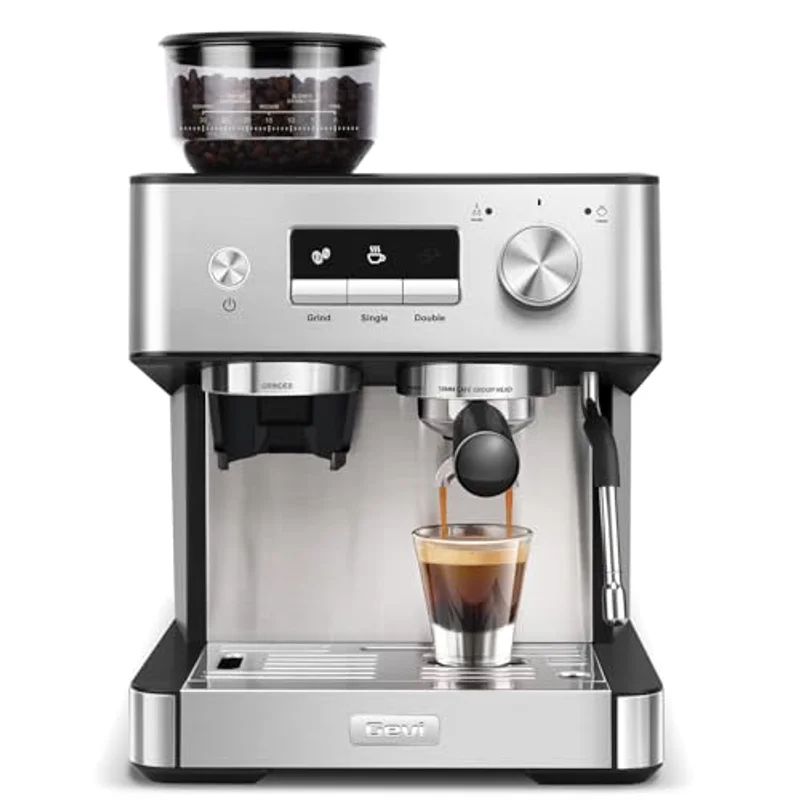
Gevi 20 Bar with Grinder — $289.99
Conical burr grinder, 30 settings · adjustable grind, strength and temperature · steam wand also dispenses hot water · 11.5 × 12.01 × 16.53 in
A step up in grinder hardware from the AMZCHEF, with a hot-water outlet that makes americanos and cup pre-heating easier. The 20-bar figure on the box is the pump's rating, not what reaches the coffee.
Check price →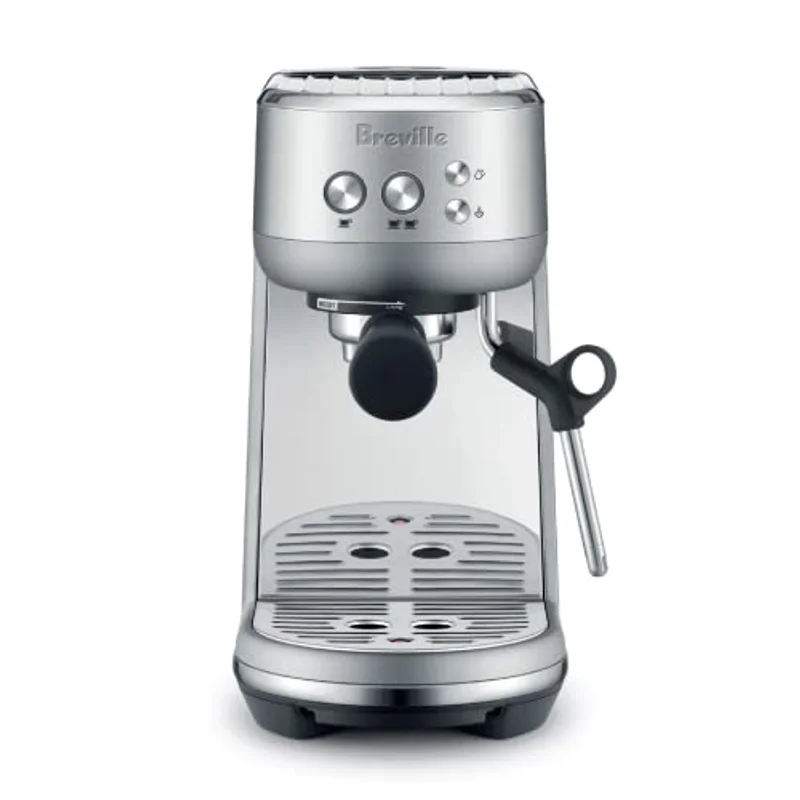
Breville BES450BSS Bambino — $249.95
Automatic microfoam steam wand (adjustable milk temperature and texture) · no grinder · compact footprint
The inverse trade: no grinder at all, and in exchange the milk side is automated to a set temperature and texture. If your daily drink is a latte or a flat white and you don't want a learning curve on the wand, this is the exception worth paying for. Pair it with a separate burr grinder.
Check price →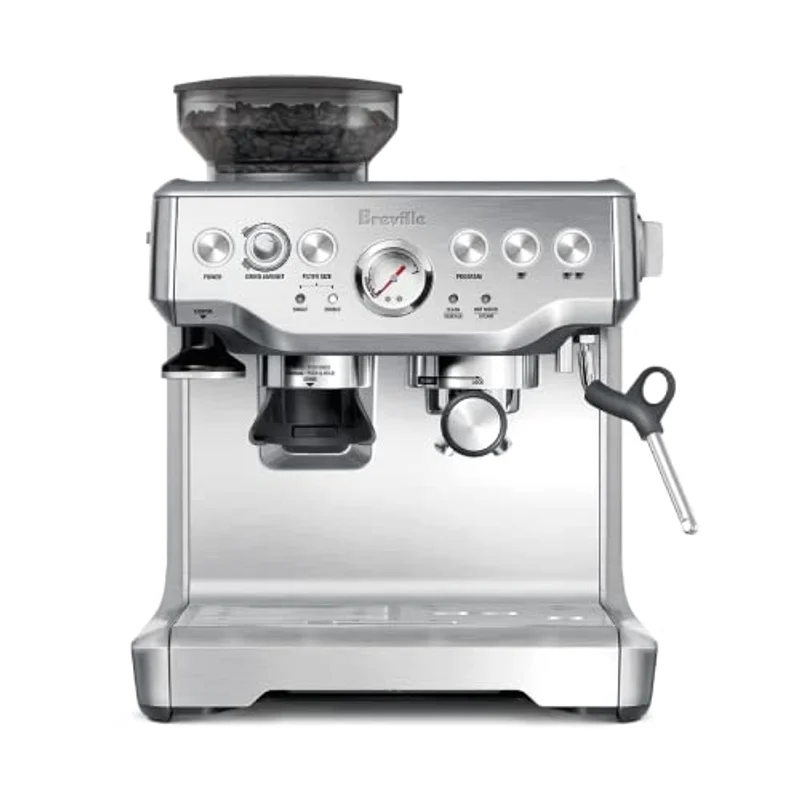
Breville BES870XL Barista Express — $684.96
Built-in conical burr with dose control · 54 mm stainless portafilter · razor dose-trimming tool · low-pressure pre-infusion · 67 oz tank · 1,600 W · integrated tamper · milk jug
This machine has anchored the "first real espresso machine" recommendation for over a decade because of its integration: it grinds on demand into the portafilter, the razor tool trims the dose to a repeatable level, and pre-infusion wets the puck before full pressure. Everything but beans is in the box. It is also big, heavy, and it asks you to learn something.
Check price →Two also-considereds: the same Barista Express in Black Truffle (BES870BTR, $499.95) and the CASABREWS CM5418 Compact at $139.99, which adds a pressure gauge. If your budget stops near $200, see the best espresso machines under $200.
What wears out: the pump, the group gasket, the shower screen and, on grinder models, the burrs — all consumable parts on a modular machine, and a semi-automatic that gets descaled and back-flushed outlives several cheaper appliances. Our cleaning and descaling guide covers the routine and the manufacturer guidance on frequency and chemicals.
Who should buy it: anyone who finds the process appealing rather than annoying, and anyone who buys beans from a roaster and wants them to taste different from each other. If that sounded like a chore, skip to the next class.
3. Super-automatic: one button, from bean to cup
A super-automatic is a small automated production line in a box. Press a button and it grinds a dose, packs it into an internal brew unit you never see, pushes water through at brewing pressure, then ejects the puck into a bin. No portafilter, no tamper, no grinds on the counter — you empty the bin every dozen drinks and refill beans and water.
The morning is twenty seconds of standing there, and that is the whole value proposition: the same drink at the same strength whether you are alert or half-asleep, without dirtying anything but the cup.
The ceiling is lower, though, and it is worth being precise about why. The internal brew unit works with fixed basket geometry and a preset pressure profile, so the machine adjusts strength by moving dose and water volume rather than letting you re-engineer the extraction. Grinders here also have fewer steps — the Magnifica Start offers 13 settings against 44 on the AMZCHEF above.
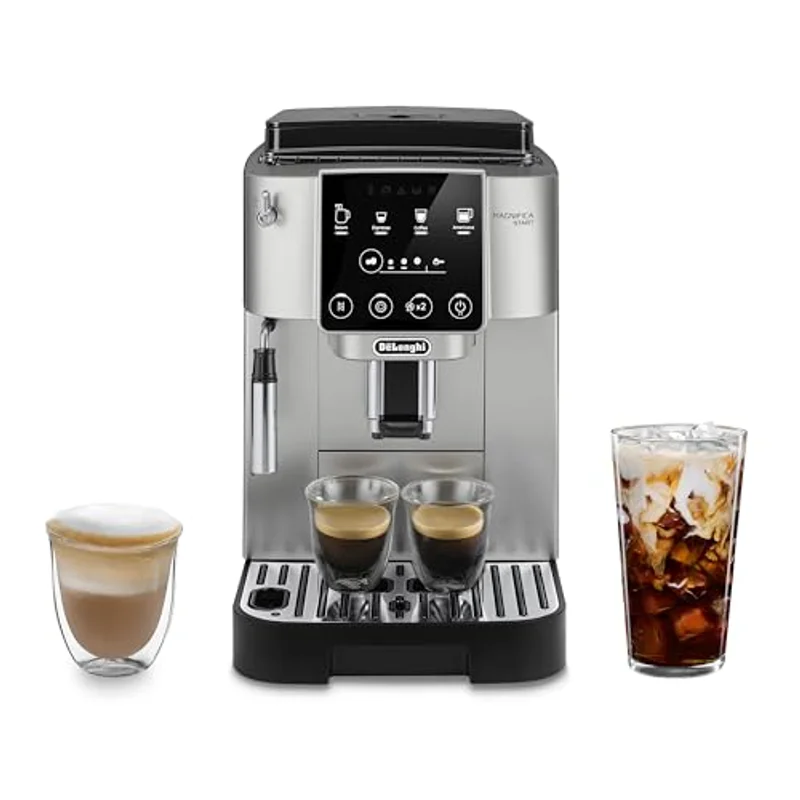
De'Longhi Magnifica Start — $689.48
Super-automatic · built-in conical burr, 13 grind settings · 3 one-touch recipes (espresso, coffee, americano) · adjustable intensity · manual milk frother
The most established name in the category, at the price where super-automatics start to make sense. Note the milk side: the frother here is manual, so a one-touch latte is not what you're buying — you get one-touch black coffee, and you steam the milk yourself.
Check price →Cost works differently too. At $689.48 the Magnifica Start sits within $35 of the Barista Express, but that money buys convenience rather than headroom — and repairs are the sharper difference. A semi-automatic is a pump, a boiler and a group head you can address individually; a super-automatic is one appliance whose grinder, brew unit, dosing mechanism and electronics are interdependent, so a fault usually means a service visit rather than a $12 gasket. Descaling is not optional either: scale inside an automated brew group is more disruptive than scale in a plain boiler.
Who should buy it: the person who wants very good coffee with zero technique and zero mess, households where several people make drinks and nobody wants to learn a grind setting, and anyone who owned a semi-automatic and stopped using it.
4. Capsule: lowest effort, and a bill that never ends
A capsule machine solves variability by taking your coffee away from you. Grind, dose and tamp were decided at the factory and sealed in a pod; the machine pierces it, pushes hot water through at pressure, and drops the capsule into a bin. Nothing to dial in, nothing to clean beyond the drip tray, no beans going stale in a hopper.
The routine takes fifteen seconds and no skill at all, which for many households is the right answer. The ceiling is set by whoever roasted and packed the capsule — choose a different pod, yes; grind finer, dose heavier or extract longer, no. Espresso from a good original-style capsule is respectable; it is not the shot a dialled-in semi-automatic makes, and it never varies in either direction.
The economics are the real decision: purchase price is low, per-cup price is permanent, and unlike beans it does not fall when you buy in bulk.
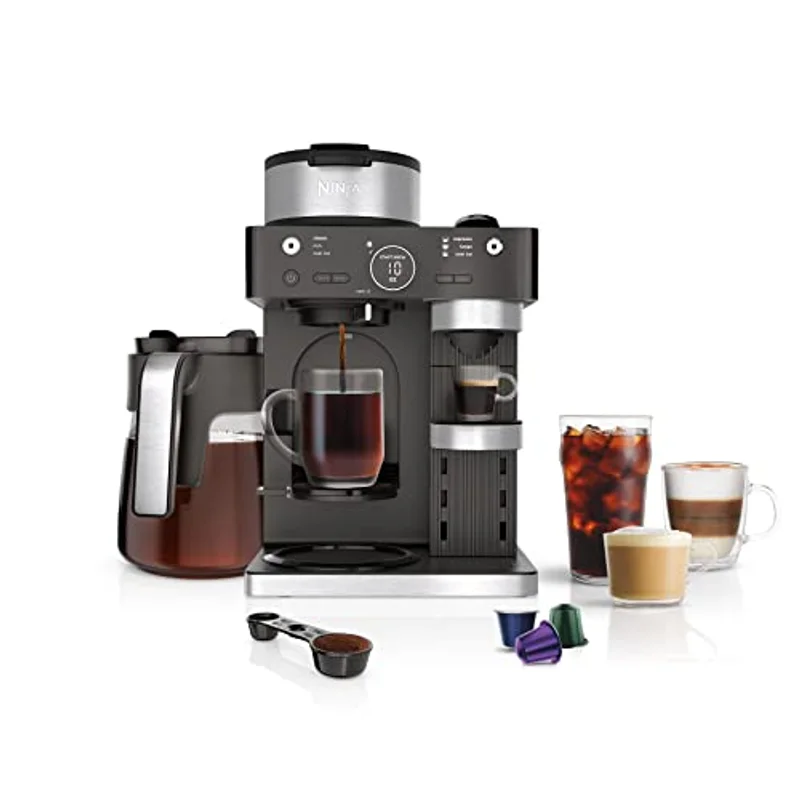
Ninja CFN601 Espresso & Coffee Maker — $229.95
Capsule + drip · Nespresso original-capsule compatible · 19-bar system · espresso 1.35 oz / lungo 3.75 oz / over-ice 1 oz · 12-cup coffee side · fold-away frother
The easiest version of the capsule argument to defend, because it isn't only a capsule machine — a full 12-cup drip side lives in the same body. For a household split between "quick espresso" and "a mug of filter coffee", it replaces two appliances.
Check price →What wears out: less than anything else here — the piercing-and-pumping mechanism does one repetitive job and never touches loose grounds. Scale still ends these machines, so descaling stays on the schedule in the manual. The other exposure is commercial: the machine stays useful only while that capsule format stays available and sanely priced.
Who should buy it: people whose priority is speed and zero cleanup, households with mixed tastes, offices and guest rooms. Not the person who wants to get better at espresso — there is nothing here to get better at.
The hybrid multi-drink machines
A newer category sits across the classes above: one appliance making espresso from loose beans plus drip coffee plus cold brew. The Ninja Luxe Café Premier is the clearest example we track — a built-in burr grinder feeding two espresso styles, three drip styles and two cold-brew styles from 6 to 18 oz, plus a dual froth system with four presets including cold foam.
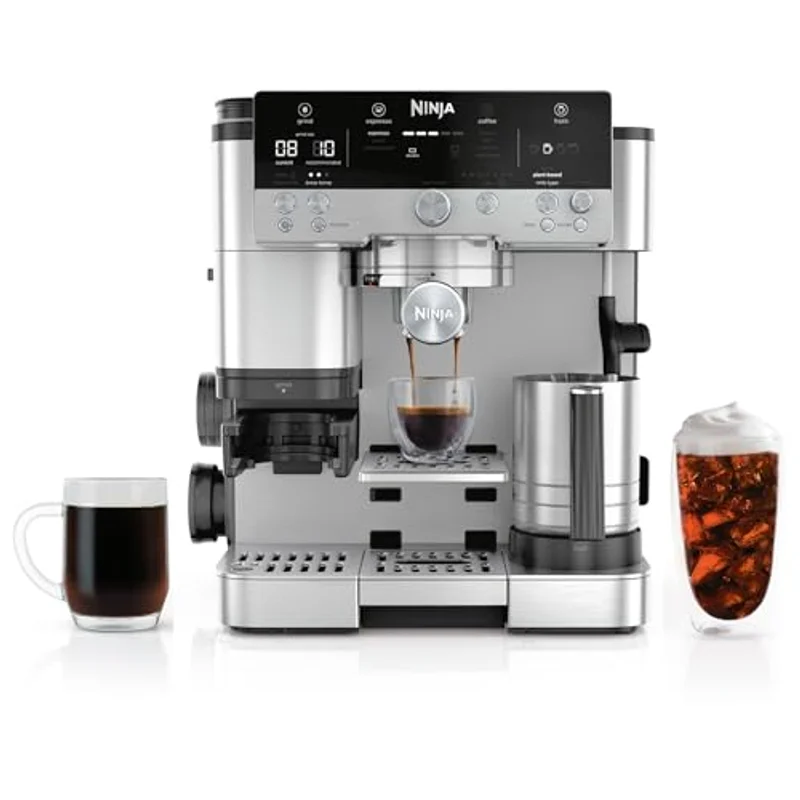
Ninja Luxe Café Premier 3-in-1 — $499.99
Espresso / drip / cold brew · built-in burr grinder · dual froth system: spinning whisk + automatic steamer, 4 presets including cold foam · 12.99 × 13.39 × 14.57 in
The buy-one-appliance answer, and the only machine here that handles cold foam without a separate gadget. The trade-off is depth: a dedicated semi-automatic at $599 has a more serious espresso ceiling, and this is a large object — measure the counter before ordering.
Check price →Judge hybrids on whether you will really use the second and third functions. If two of the three modes go unused, you have bought a mid-range espresso machine at a large-machine footprint.
The bar number on the box tells you nothing
Espresso is extracted at roughly 9 bar of pressure at the coffee puck — the figure the drink is defined around, and the reference point in commercial machines for decades. So when a listing shouts 15 bar, 19 bar or 20 bar, it is not saying the machine brews harder than a café machine. It is quoting the maximum rating of the pump: a component spec, measured with no coffee in the way.
Every pump machine on this page comfortably reaches brewing pressure. What the coffee sees is set by the machine's regulation and, above all, by the resistance your grind and dose create: a fine grind and a level tamp raise it, a coarse or uneven puck lets water through too fast no matter what the pump is rated for. Which is exactly why a $200 machine with a good grinder beats a $100 machine with a bigger number on the box.
Treat the bar figure like the top speed printed on a car's dashboard: real, unreachable in normal use, irrelevant to your commute. Read these instead — is there a burr grinder, is the grind adjustable in useful steps, is brew temperature stable, how big is the boiler, how is the milk handled.
Milk is a real decision axis, not an afterthought
If your daily drink is a latte or a flat white, most of what lands in the cup is milk — so the milk hardware deserves as much weight as the grinder.
A manual steam wand gives you a jet of steam and full authority over it. You position the tip to introduce air, drop it in to make a whirlpool, feel the jug get hot and stop at the right moment. Done well, that produces glossy microfoam that pours latte art and integrates into the espresso instead of sitting on top as a foam hat. Done badly, big bubbles and scalded milk.
An automatic frother — the Bambino's microfoam wand, or the Ninja Luxe Café's dual froth system — texturises to a preset temperature and foam level while you do something else. You lose fine control; you gain a routine that survives a Tuesday when you're already late. For most weekday drinkers, an automatic system used correctly beats a manual wand used impatiently.
One constraint applies to every affordable machine here: a single small boiler heats both brew water and steam, and steam needs a much higher temperature. So you pull the shot, wait while the boiler climbs, then froth. That wait is short on the Bambino and longer at the bottom of the range — the 1,350 W CASABREWS 3700 is fine for a cup or two a day, but four milk drinks in a row means standing around.
So which one is you?
Four honest profiles. Pick the one that describes your life, not your ambitions.
You find the process interesting
You want to weigh doses, taste the difference between two roasters, get better at something. Buy a pump semi-automatic with a grinder attached, once: the Breville Barista Express at $684.96, where nothing about the machine limits you while you learn. If that's out of reach, the AMZCHEF at $199.99 is the same shape of machine for under a third of the price. Either way, run the payback math first.
You drink one latte, on weekdays, in a hurry
Your bottleneck is milk and time, not extraction. Buy the Breville Bambino at $249.95 plus a separate burr grinder: the automatic wand removes the step that most often goes wrong at 7:20am, and a standalone grinder survives your next machine.
Your household wants three different drinks
Espresso for one person, filter coffee for another, cold brew with cold foam for a third. If loose beans matter, the Ninja Luxe Café Premier at $499.99 covers all of it on one grinder and one froth system. If nobody wants to think about grind at all, the Ninja CFN601 at $229.95 pairs capsule espresso with a 12-cup drip side for less than half the money — and a permanent per-capsule cost.
You just want to press a button
Coffee is fuel and mess is the enemy. Buy a super-automatic: the De'Longhi Magnifica Start at $689.48 grinds, doses, tamps and brews three recipes from one press. Two caveats: the frother is manual, and repairs on an integrated appliance cost more.
And if you were about to buy the $54.99 steam machine because it says espresso on the box: the extra $25 to the Chefman CraftBrew at $99.99 buys a real pump — the difference between strong coffee and espresso.
How we reached these conclusions
We compare published specifications, what ships in the box, machine class, footprint, wattage, tank size and live pricing. We do not physically test these machines, we do not run a testing lab, and we do not publish ratings we cannot verify — Amazon's product data returns no rating or review-count figures for this category, so you will not find a star score anywhere on this site.
Where something here is a judgement rather than a specification, it is our reasoning from machine class and general coffee facts, said in our own voice. Prices move constantly; confirm the current one before you buy.
Frequently asked questions
Is a semi-automatic or a super-automatic better for a beginner?
A super-automatic is easier from the first cup: it grinds, doses, tamps and brews behind one button, so you get a consistent drink immediately and no mess. A semi-automatic asks you to learn grind, dose and shot timing over a couple of weeks, and rewards that with a higher ceiling and cheaper, modular repairs. If making coffee sounds like a hobby, start semi-automatic; if it sounds like a chore, start super-automatic.
Are steam-driven espresso machines real espresso machines?
Not in the strict sense. A steam-driven machine has no pump — it uses steam pressure built up in a sealed boiler, which lands well below the roughly 9 bar that defines espresso extraction. The result is strong, concentrated coffee with a thin, short-lived foam rather than true crema. If espresso is the goal, a basic pump machine around $80 is a different category of result.
Does a 20-bar pump make better espresso than a 9-bar one?
No. Espresso brews at roughly 9 bar at the puck, and a 15-bar or 20-bar figure on the box is the pump's maximum rating measured with no coffee in the way. Every pump machine here reaches brewing pressure, and what the coffee sees is governed by your grind and dose. Judge the grinder, brew-temperature stability and the milk system instead.
Do I need a manual steam wand to make good lattes?
No, but be honest about which system you'll use well. A manual wand gives full control and the best microfoam in practised hands, at the cost of a learning curve; an automatic frother textures to a preset temperature and foam level while you do something else. Note too that affordable machines share one small boiler between brewing and steaming, so expect a wait between shot and milk.
Keep reading
- Espresso machine with grinder vs separate grinder
- How to pull a good espresso shot — 18 g in, 36 g out, and what to change when it tastes wrong.
- The best espresso machines under $200
- Are home espresso machines worth it? — the payback math, with assumptions written out.
- How to clean and descale an espresso machine
- All eight of our current picks, ranked — or browse every guide.